MeshAdv Pi Hat
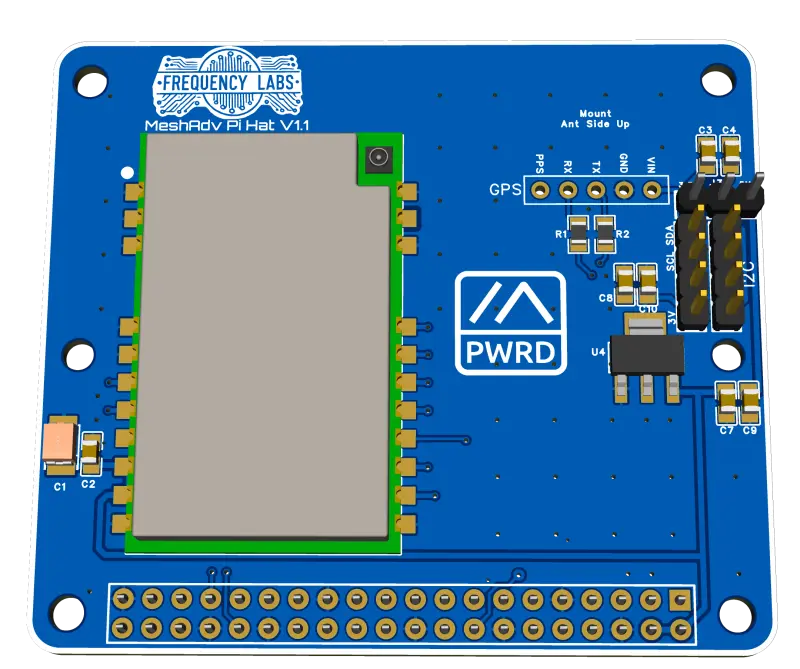
A high-power 1 Watt LoRa expansion board for Raspberry Pi designed for use with the Linux-native Meshtastic daemon. It features an Ebyte E22 LoRa module, integrated GPS support, and I2C breakouts, making it ideal for permanent base stations or router nodes.
Overview
The MeshAdv Pi Hat is a specialized hardware expansion board designed to transform a Raspberry Pi into a powerful Meshtastic node. Unlike standard low-power LoRa modules, this hat utilizes a 1 Watt Ebyte E22 module, providing significantly increased range and penetration for mesh networking. It is specifically tailored for the Linux-native version of Meshtastic, known as meshtasticd, allowing users to leverage the full processing power and connectivity of the Raspberry Pi platform.
Key Features and Capabilities
The board is engineered for reliability and long-term deployment, particularly as a “Base Station” or “Router” node. By using a Raspberry Pi as the host, users can mount the node in high, remote locations and manage it entirely over a network via SSH or MQTT, eliminating the need for physical access to update firmware or change configurations.
Core hardware features include:
- High-Power LoRa: Support for 1W Ebyte E22-900M30S/M33S (SX1262) or E22-400M30S/M33S (SX1268) modules.
- Integrated GPS Support: Dedicated space for an ATGM336H GPS module with PPS (Pulse Per Second) routing for precise timekeeping.
- I2C Breakout: Easy expansion for sensors or displays via the I2C bus.
- Flexible Powering: Designed to work seamlessly with separate POE adapters for single-cable installations.
- Wide Compatibility: Supports almost the entire Raspberry Pi family with a 40-pin header, from the Zero and Zero 2 W to the Raspberry Pi 4 and 5.
Technical Implementation
The MeshAdv Pi Hat interfaces with the Raspberry Pi through the standard 40-pin GPIO header. It utilizes the SPI bus for LoRa communication and UART for GPS data. A critical safety feature of the design is the requirement for a connected antenna during operation; powering the 1W E22 module without a load can lead to hardware damage.
Pin Mapping
The hardware uses a specific GPIO layout to interface with the Linux environment:
- LoRa SPI: MOSI (GPIO 10), MISO (GPIO 9), CLK (GPIO 11), NSS (GPIO 21)
- LoRa Control: RST (GPIO 18), BUSY (GPIO 20), IRQ (GPIO 16), TXEN (GPIO 13), RXEN (GPIO 12)
- GPS UART: TX (GPIO 14), RX (GPIO 15), PPS (GPIO 23)
- I2C: SDA (GPIO 2), SCL (GPIO 3)
Software Configuration
Setting up the MeshAdv Pi Hat involves configuring the meshtasticd service on Raspberry Pi OS. The configuration is handled via a YAML file, where users define the specific LoRa module pins and GPS paths.
Lora:
  Module: sx1262
  CS: 21
  IRQ: 16
  Busy: 20
  Reset: 18
  TXen: 13
  RXen: 12
  DIO3_TCXO_VOLTAGE: true

GPS:
  SerialPath: /dev/ttyS0

I2C:
  I2CDevice: /dev/i2c-1
For users who prefer a more automated setup, the project creator provides a configuration tool to streamline the installation of the Meshtastic daemon and the necessary environment settings. This makes the MeshAdv Pi Hat an accessible yet professional-grade solution for building robust, long-range mesh communication infrastructure.