Level RISC-V
Level-V is an open-source, 5-stage in-order RISC-V processor core implementing the RV32IMC instruction set. Designed for simulation, verification, and SoC experimentation, it features a sophisticated memory hierarchy including L1 and L2 caches, a tournament branch predictor, and a comprehensive verification suite integrated with tools like Verilator and Spike.
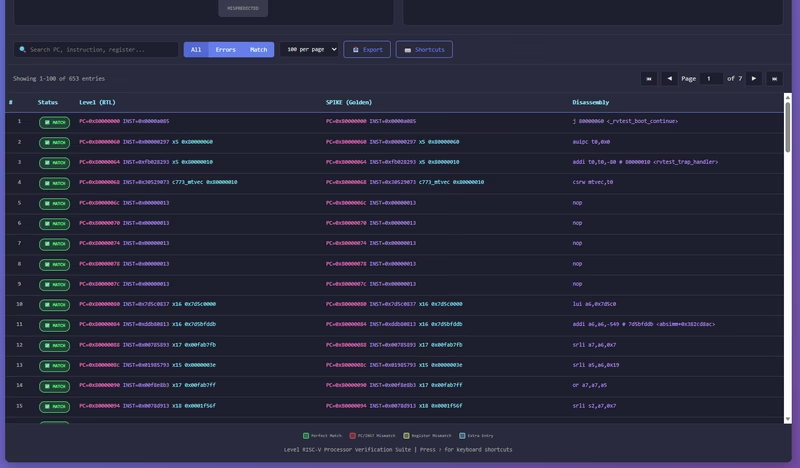
Level-V is a robust, open-source implementation of a RISC-V processor core designed specifically for developers and researchers who need more than just a minimal “toy” core. Implementing the RV32IMC ISA—covering integer, multiplication, and compressed instruction extensions—it strikes a balance between complexity and accessibility, making it an ideal platform for SoC experiments and architecture research.
Architecture and Pipeline
The core is built around a classic 5-stage in-order pipeline, but it differentiates itself through a highly capable frontend. It features an align buffer to handle the complexities of RV32C (compressed) instruction decoding and a sophisticated tournament branch predictor. This prediction unit combines GShare and bimodal algorithms with a Branch Target Buffer (BTB) and a Return Address Stack (RAS). For those looking to experiment with memory latency, the fetch path also includes an optional next-line prefetcher to keep the pipeline fed.
Advanced Memory Hierarchy
One of the standout features of Level-V is its flexible memory system. While many embedded cores rely on simple bus interfaces, Level-V provides a full L1 instruction and data cache hierarchy with Physical Memory Attributes (PMA) support.
For more advanced configurations, the project includes an optional non-blocking, multi-bank, multi-port L2 cache (nbmbmp_l2_cache). This L2 implementation features separate instruction and data pipes, dual-port BRAM arrays, and a Miss Status Holding Register (MSHR) to handle concurrent misses. It utilizes a MESI-style tagging system and a write-back policy toward the Wishbone-compatible system bus.
Verification-First Design
Verification is not an afterthought in the Level-V ecosystem. The repository is pre-configured with a comprehensive toolchain that integrates several industry-standard verification flows:
- Spike Co-simulation: Real-time commit-trace comparison against the Spike ISA simulator ensures functional correctness.
- Standard Test Suites: Integrated support for
riscv-tests,riscv-arch-test, and Imperas flows. - Advanced Stimulus: Hooks for
riscv-dv(constrained random instruction generation) andriscv-formal(bounded formal checks). - Observability: The system generates Spike-style commit traces and Konata-compatible pipeline exports, allowing developers to visualize instruction flow and stalls in high resolution.
Performance and Tooling
In terms of raw performance, Level-V achieves approximately 2.62 CoreMark/MHz and 1.51 DMIPS/MHz when simulated with Verilator. The project is heavily oriented toward an open-source tool stack, relying on Verilator for fast RTL simulation, Yosys for synthesis and linting, and Python-based tooling for test orchestration and dashboard generation.
Developers can quickly spin up a simulation environment using the provided Makefile. The environment supports building custom bare-metal C tests using the standard RISC-V GCC toolchain, with output viewable via a simulated UART monitor. For those interested in physical implementation, the project also includes assets for the OpenLane ASIC flow, providing a path from RTL to GDS layout.
Related Projects
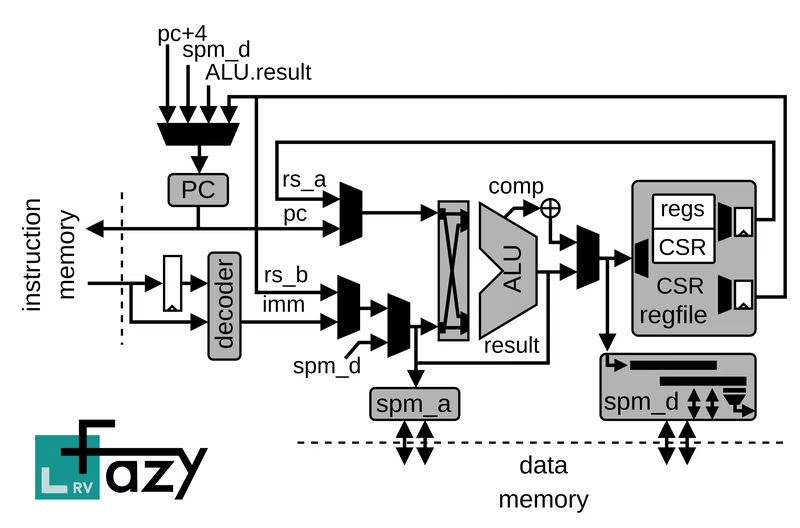
FazyRV -- A Scalable RISC-V Core
FazyRV is a minimal-area RISC-V RV32 core featuring a scalable data path that can be configured to 1, 2, 4, or 8 bits at synthesis time. It is designed for resource-constrained FPGA architectures like iCE40 and ECP5, offering fine-tuned trade-offs between hardware area and performance while maintaining compatibility with the LiteX SoC builder.