Leta
Leta is an open-source smartwatch project built on the STM32F103 microcontroller, featuring a custom-written mini RTOS and a sophisticated monochrome GUI library. It integrates a variety of sensors including an IMU, magnetometer, and environmental sensors, alongside Bluetooth connectivity and a 1.3-inch OLED display.
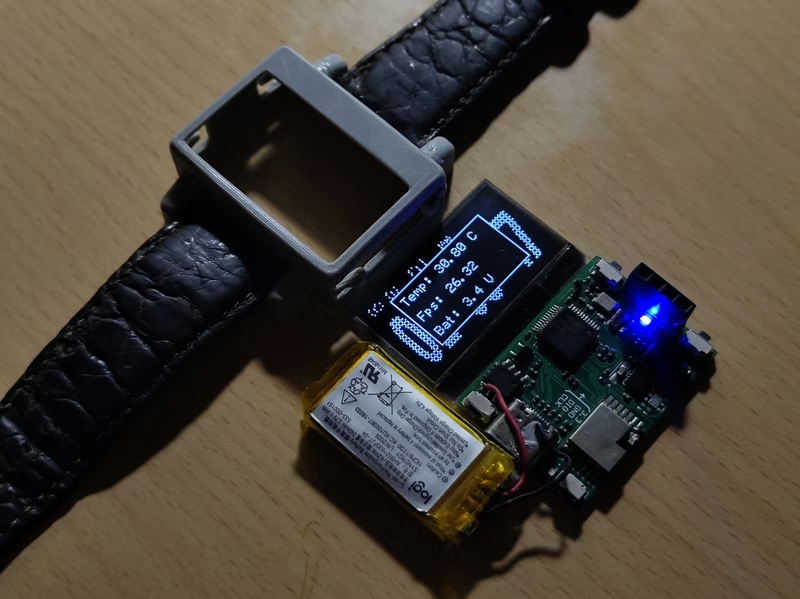
Leta, named after the Russian word for summer, is a custom-built wrist watch project that started during the summer months. It represents a comprehensive exercise in embedded systems design, combining hardware engineering, real-time operating system development, and user interface design to create a functional, wearable device.
Hardware Architecture
The project is powered by an STM32F103xx microcontroller, which provides 128 kB of ROM and 20 kB of RAM, along with a built-in Real-Time Clock (RTC) for accurate timekeeping. The hardware suite is quite capable for its size, featuring several sophisticated components:
- Sensors: An MPU6050 IMU and HMC5883L magnetometer for motion and orientation tracking, and an HTU21D for ambient temperature and humidity monitoring.
- Connectivity: Bluetooth communication via the RF-BM-4044B4 (RF-Star) module.
- Display: A 1.3-inch SH1106 OLED screen with a resolution of 128x64.
- Power Management: A TP4056 charger IC paired with an AP2112 3.3V regulator.
PCB and Enclosure Design
The electronics are mounted on a custom 2-layer PCB designed for a compact form factor. The board includes a USB interface for charging, an SWD port for firmware debugging, and four physical buttons for user input.
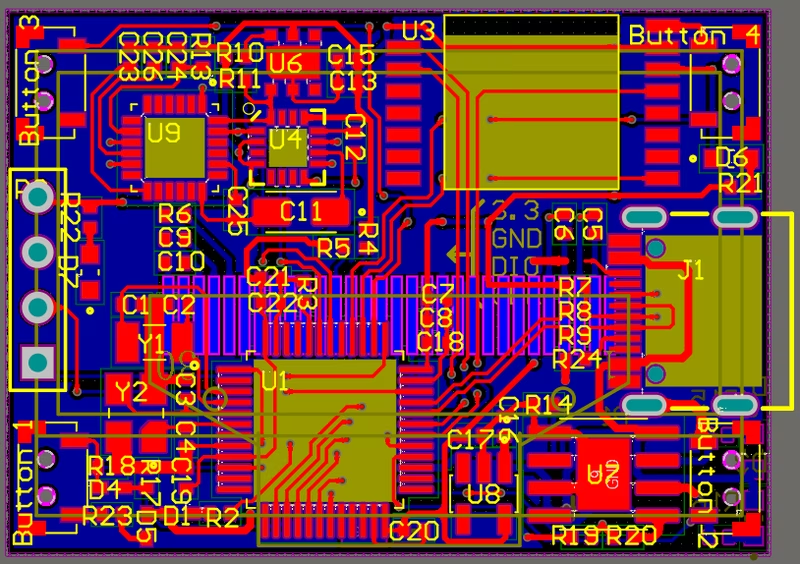
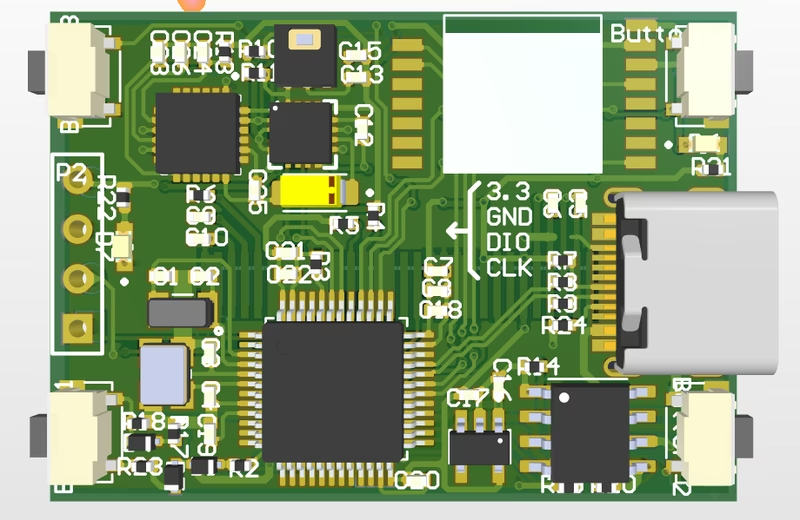
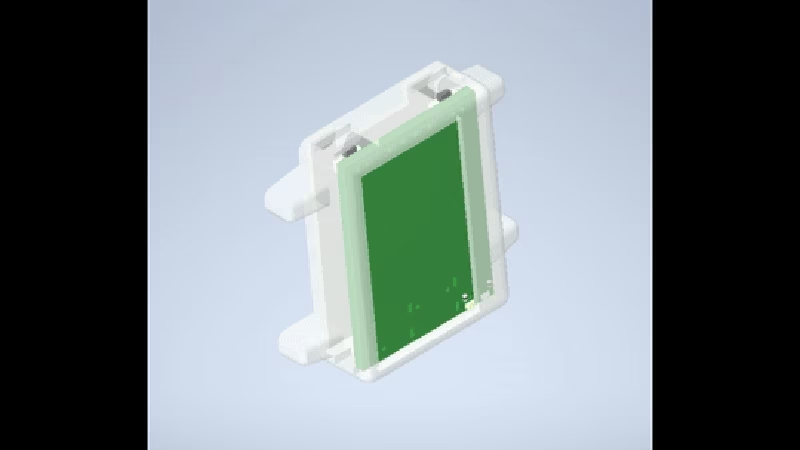
To complete the watch, the project includes a custom-designed enclosure that houses the PCB and the battery, ensuring the device is wearable and protected.
Software Layers
The firmware architecture of Leta is divided into distinct layers, ensuring modularity and ease of development. It relies on two primary custom software components: AK-mOS and a specialized GUI library.
AK-mOS
Leta runs on AK-mOS, a mini Real-Time Operating System (RTOS) written specifically for ARM Cortex-M3 devices. While created for learning purposes, it is a capable kernel with a context-switching mechanism based on FreeRTOS. Its features include:
- Preemptive and Round-robin scheduling.
- Inner-task communication mechanisms.
- Software timers for managing periodic events.
Monochrome OLED GUI
To overcome the limitations of a small monochrome display, the project utilizes a custom GUI library designed to provide a rich, animated user experience. The library supports various widgets such as switches, checkboxes, sliders, and pop-up notifications. It also includes an animation engine capable of handling fading, moving, and resizing transitions for UI elements, significantly improving the visual quality of the watch interface.