Digital Synth PRA32-U2
A 4-voice polyphonic synthesizer designed for the Raspberry Pi Pico 2 and RP2350 microcontroller. It features built-in chorus and delay effects, MIDI control via USB or UART, and support for high-quality I2S DACs or PWM audio output.
Overview
The Digital Synth PRA32-U2 is a sophisticated 4-voice polyphonic synthesizer specifically optimized for the Raspberry Pi Pico 2 and its RP2350 microcontroller. Serving as an upgraded successor to the original PRA32-U, this project transforms the RP2350 into a fully functional MIDI sound module. It combines a versatile synthesis engine with integrated digital effects, making it a compact yet powerful tool for electronic music production and embedded audio experimentation.
Hardware and Audio Architecture
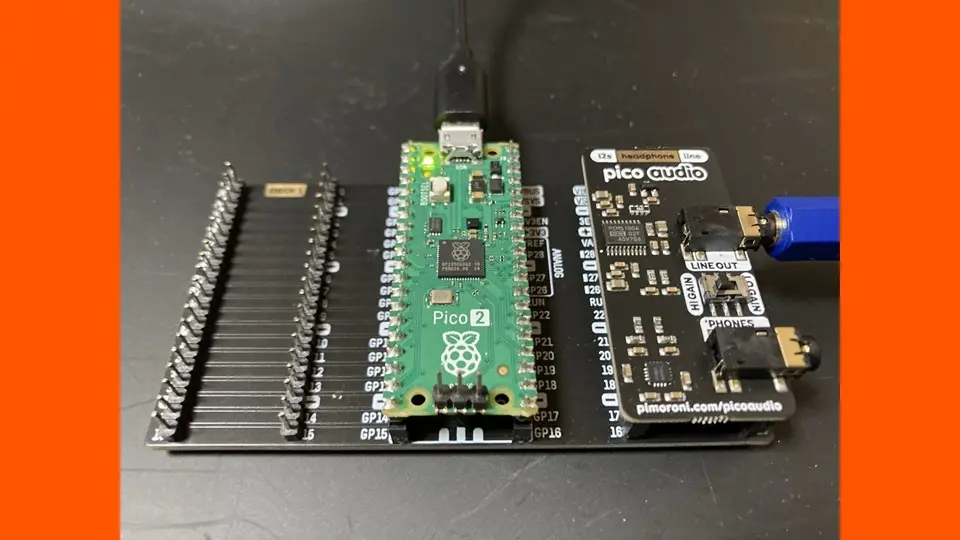
The project is built around the high-performance RP2350, leveraging its processing power to handle real-time synthesis and effects. For audio output, the system primarily targets I2S DACs, such as the Pimoroni Pico Audio Pack or Texas Instruments PCM510x series modules. It operates at a 48 kHz sampling rate with 16-bit depth.
While I2S is the recommended output method for high-fidelity sound, the project also includes an optional PWM audio mode. This allows users to generate sound directly from the microcontroller pins with a simple RC filter, though it is currently noted as a secondary option due to potential signal discontinuity issues. To ensure optimal performance during audio processing, the system clock is typically overclocked to 153.6 MHz.
Synthesis Engine and Effects
The PRA32-U2 features a classic subtractive synthesis architecture enhanced with modern digital capabilities:
- Oscillators: Two oscillators per voice. Oscillator 1 supports Saw, Square, Triangle, Sine, and Pulse waves, along with specialized Wave Tables. Oscillator 2 includes Saw, Square, Triangle, Sine, and White Noise options.
- Filter and Envelope: A resonant filter with Low Pass and High Pass modes, controlled by dedicated Envelopes (EG) and LFOs. The filter implementation includes soft clipping for added character.
- Modulation: A flexible LFO with multiple waveforms (including Sample & Hold) that can target pitch, filter cutoff, or oscillator shape.
- Built-in FX: The signal chain concludes with integrated Chorus and Delay effects, providing spatial depth and texture without requiring external processing.
MIDI Control and Editing
As a MIDI sound module, the PRA32-U2 is designed to be played and controlled via external hardware or software. It supports:
- USB MIDI: Default operation as a USB MIDI device using the Adafruit TinyUSB stack.
- UART MIDI: Optional support for traditional DIN/TRS MIDI connections via UART pins, which can help avoid USB-related electrical noise.
- Web-Based Editor: The project includes a dedicated HTML/Web MIDI application (
pra32-u2-editor.html). This editor allows users to modify parameters, manage user presets, and even perform “Random Synth” generation to discover new sounds.
The PRA32-U2/P Control Panel
For users seeking a standalone hardware instrument, the project offers the PRA32-U2/P configuration. This version adds a physical user interface consisting of:
- A 128x64 OLED display (SSD1306).
- Tactile switches for navigation and playback.
- Potentiometers for real-time parameter manipulation.
- An 8-step monophonic sequencer with internal or external clock synchronization.
Technical Implementation
The project is developed using the Arduino IDE and the Arduino-Pico core by Earle F. Philhower, III. It relies on the standard Arduino MIDI Library for message handling. The repository provides the complete source code, including Ruby scripts for generating wave tables and a C++ utility for generating sample WAV files on a PC for debugging purposes. For those who prefer not to compile from source, prebuilt UF2 files are available for immediate deployment to Raspberry Pi Pico 2 hardware.