CRose (China Rose) Lightweight Data Engine
CRose is an integrated industrial data platform designed for manufacturing and modern agriculture, providing a full-stack solution from hardware protocol collection to statistical analysis. It leverages a containerized architecture featuring Node-RED, IoTDB, and AI-driven flow generation to simplify edge device management and data orchestration.
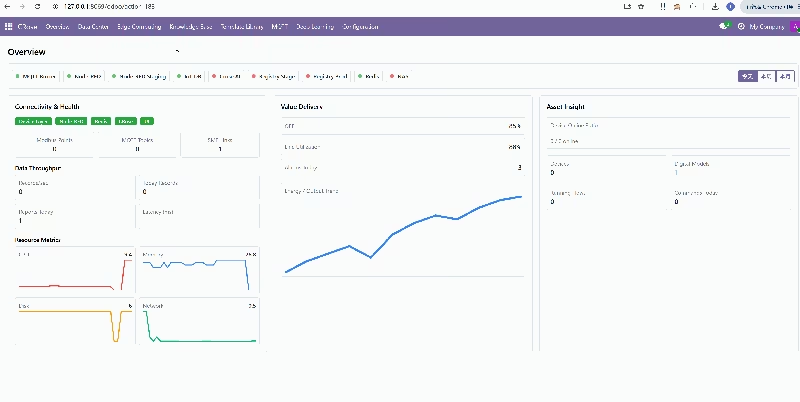
Bridging the Gap in Industrial Data
In the realms of manufacturing and modern agriculture, the journey from raw sensor data to actionable insights is often fraught with integration hurdles. CRose (China Rose) emerges as an integrated, lightweight data engine designed to collapse this complexity. By encapsulating a full stack of capabilities—from underlying protocol collection via Modbus and MQTT to upper-level statistical analysis and UI visualization—CRose provides an out-of-the-box platform for industrial-grade IoT.
The project is built on the philosophy of simplicity without sacrificing power. It targets environments where rapid deployment and reliable data governance are paramount, such as machine tool monitoring, injection molding optimization, and environmental sensor networks.
A Comprehensive Integrated Stack
CRose is delivered as a containerized ecosystem, allowing users to launch a complete industrial data stack with a single command. The architecture integrates several high-performance components:
- Node-RED: Serves as the low-code logic engine for data acquisition and transformation.
- IoTDB: A high-performance time-series database optimized for IoT data storage.
- GMqtt: A Golang-based MQTT broker designed for efficient message handling.
- Redis: Utilized for high-speed caching and real-time state management.
- Odoo: Provides the framework for business logic and management interfaces.
This “all-in-one” approach eliminates the need for manual integration and tuning of disparate services, ensuring that data collection begins immediately upon deployment.
AI-Driven Data Acquisition
One of the most innovative features of CRose is its integration of large language models (LLMs) to lower the barrier to entry for low-code development. Instead of manually handcrafting Node-RED flows from scratch, users can describe their requirements in natural language. For example, a user might state: “Read PLC D100 every 10 seconds and trigger an alert if the value exceeds 80.”
The system processes this natural language input, matches it against a library of over 20 scenario-based templates (covering Modbus RTU/TCP, OPC UA, S7, etc.), and automatically generates executable flows. This capability significantly accelerates the deployment of new sensors and equipment on the factory floor.
Large-Scale Edge Fleet Management
CRose is designed with the reality of distributed industrial environments in mind. It provides robust tools for managing hundreds of edge nodes, such as Raspberry Pis or industrial PCs, from a centralized interface. Key management features include:
- Batch Deployment: Simultaneous updates across the entire fleet.
- Version Control: Capability for flow updates and version rollbacks to ensure stability.
- Configuration Drift Detection: Identifying nodes that have deviated from the intended setup.
- Remote Ops: Fully remote operations designed for geographically dispersed equipment.
Native Data Quality and Observability
Data is only valuable if it is trustworthy. CRose includes native data quality governance that performs schema checks at the point of ingestion. This includes validating units, ranges, and non-null constraints, effectively flagging anomalies before they reach the storage layer.
To maintain system health, the platform offers end-to-end observability. Users can monitor collection health through a dedicated dashboard, track throughput statistics (messages per second and storage footprint), and observe resource trends like CPU and memory usage on edge nodes. This transparency allows operators to identify and resolve bottlenecks before they impact production.