BSH Home Appliances D-Bus Interface
A reverse-engineering project focused on the proprietary D-Bus protocol used in BSH (Bosch, Siemens, Neff) home appliances. It provides hardware designs and software implementations for ESP32 and Arduino to monitor, analyze, and control appliances like washing machines and dishwashers.
Unlocking the Inner Workings of BSH Appliances
B/S/H/ is a global giant in the home appliance market, producing thousands of dishwashers and washing machines every day under brands like Bosch, Siemens, Gaggenau, and Neff. Despite their ubiquity, the internal communication protocols and electronics of these machines have remained largely a mystery to the public. This project changes that by providing a comprehensive look into the reverse-engineered hardware and software of BSH appliances, specifically focusing on the proprietary serial bus known as D-Bus.
The project targets a specific generation of appliances utilizing “EP” circuit boards, such as the EPW (Washing Machine), EPT (Dryer), and EPG (Dishwasher). By tapping into these systems, developers can monitor sensor data, track cycle progress, and even inject commands to automate or integrate these appliances into modern smart home ecosystems.
The Hardware Architecture
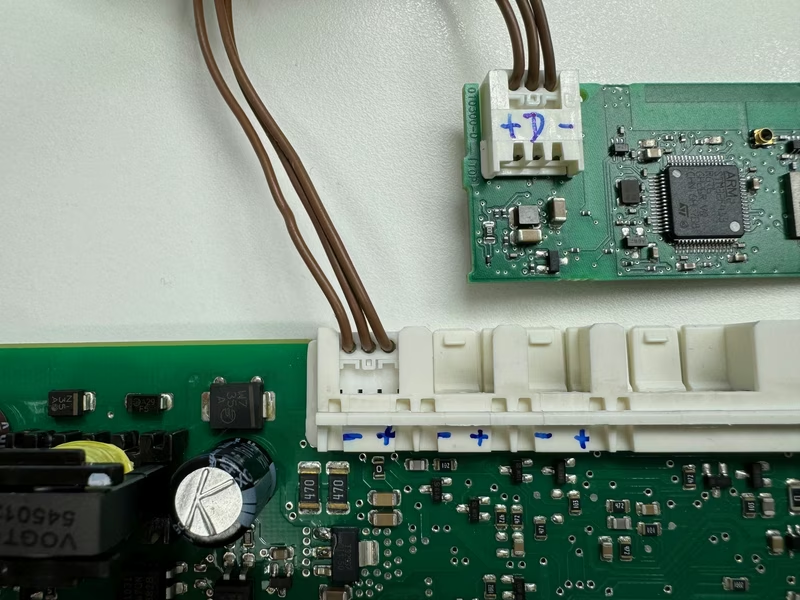
At the heart of many BSH washing machines, such as the Siemens WM14S750, lies the EPW66018 power module. This board is powered by an NXP (formerly Freescale) MC9S12Q128C-PBE16 MCU. These modules are interconnected with user interface panels and specialized sensors—like the Seuffer 3D Hall-effect unbalance sensor—via standardized RAST connectors.
Interestingly, the control electronics often share similarities with automotive industry standards, a nod to the BSH PED site in Regensburg where these systems were developed. While most components operate at low voltages, they are frequently not isolated from the mains earth, necessitating extreme caution and the use of optoisolators or battery-powered tools when interfacing with the hardware.
Deep Dive into the D-Bus Protocol
The lifeblood of these appliances is D-Bus (or D-Bus-2), a proprietary 1-wire serial bus. It operates as a multi-master bus using a non-persistent CSMA scheme, typically running at 9600 baud with 8N1 UART framing.
Frame Structure
Communication on the bus is organized into frames containing length, destination/subsystem identifiers, message data, and a CRC16-XMODEM checksum. A typical frame follows this format:
LL DS MM MM MM MM MM RR RR

LL = Length of message data
DS = Destination node and Subsystem nibble
MM = Message data (commands and parameters)
RR = Checksum
One of the most critical aspects of D-Bus is the acknowledgement byte. After a frame is correctly received, the destination node immediately sends an ACK byte. If the sender fails to see this byte, it performs a random backoff and attempts retransmission. This timing-sensitive behavior requires precise implementation in custom software stacks.
Interfacing and Software Support
To bridge the gap between the appliance and modern software, the project offers several paths for developers. Hardware enthusiasts have contributed various adapter designs, ranging from minimalist ESP32-based connectors to more robust PCB designs like the BaSHi adapter. These adapters typically utilize a level shifter to handle the 5V TTL DATA line and a DC-DC converter to draw power from the appliance’s VBUS (which can range from 5V to 13.5V depending on the machine type).
On the software side, the project includes:
- Arduino/ESP32 Stacks: The
Open-D-Busimplementation provides a structured way to parse traffic and route commands to handler functions. - ESPHome Integration: A custom component allows for seamless integration into Home Assistant, turning physical washing machine states into digital sensors.
- Web Analyzer: A client-side HTML tool is available for quick hex dump analysis, helping users decode bus traffic without installing complex tools.
Firmware Analysis and Subsystems
For those interested in the deeper logic of the machines, some BSH components ship without readout protection. This has allowed for the identification of firmware structures that define subsystems and command handles. One particularly useful discovery is Subsystem S=0, which appears to be universal across many devices. It supports commands to dump memory content (Flash and RAM) directly over the D-Bus, providing a convenient way to extract firmware for static analysis in reverse engineering tools.