BirdNET for STM32
A specialized framework for training and deploying BirdNET audio classification models on the STM32N6570-DK development board. It provides a complete pipeline from dataset preparation and TensorFlow training to optimized NPU deployment using STMicroelectronics' X-CUBE-AI tools.
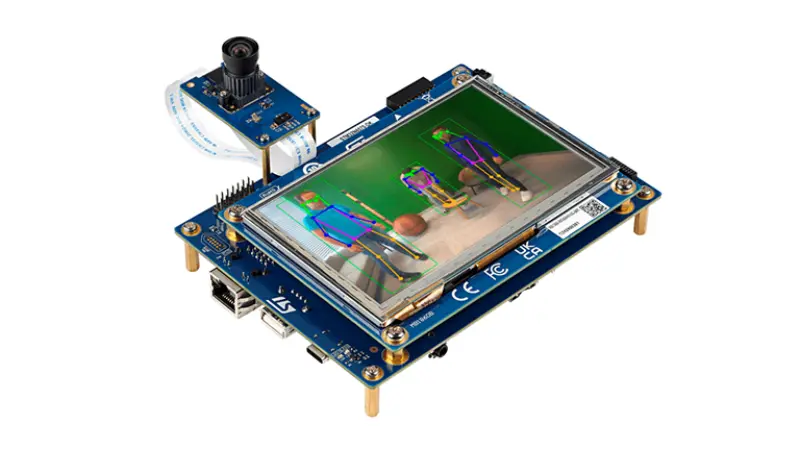
Overview
BirdNET-STM32 is a comprehensive project designed to bring advanced bioacoustic monitoring to edge devices. It focuses on the deployment of the BirdNET audio classification model onto the STM32N6570-DK development board, leveraging the high-performance capabilities of the STM32N6 series and its integrated Neural Processing Unit (NPU). The repository provides a full-stack workflow, covering dataset preparation, model training in TensorFlow, quantization, and final deployment using the ST Edge AI ecosystem.
Hardware and Performance
The primary target for this project is the STM32N6570-DK, a development platform featuring the STM32N6 microcontroller. This chip is particularly well-suited for audio AI tasks due to its dedicated NPU, which significantly accelerates deep learning inference.
According to the project documentation, a pre-trained model optimized for this platform can perform inference on a single audio chunk in approximately 3.3 ms. This performance is roughly 900 times faster than real-time, allowing for extremely low power consumption or the ability to process multiple audio streams simultaneously.
Technical Architecture
The project utilizes a Depthwise Separable Convolutional Neural Network (DS-CNN) architecture. One of the unique aspects of this implementation is the flexible audio frontend, which supports several modes:
- Precomputed/Librosa: Mel spectrograms computed offline.
- Hybrid: Linear magnitude spectrograms provided to the model, which then applies fixed mel scaling.
- Raw/TF: Raw audio provided directly to the model, with a TensorFlow-based frontend producing features internally.
This flexibility allows developers to balance the computational load between the MCU’s general-purpose cores and the NPU.
Deployment Pipeline
The deployment process is integrated with STMicroelectronics’ X-CUBE-AI framework. The workflow follows these critical steps:
- Training: Using
train.py, users can train custom models on subsets of the iNatSounds dataset or their own recordings. - Conversion: The
convert.pyscript transforms Keras models into quantized TFLite models using Post-Training Quantization (PTQ). - ST Edge AI Generation: The
stedgeaiCLI tool converts the TFLite model into optimized C code specifically tailored for the STM32N6 NPU. - On-Device Validation: The project includes scripts to validate the model’s performance directly on the target hardware, comparing on-device output against reference Keras results to ensure numerical accuracy.
Getting Started
The repository includes a pre-trained model (birdnet_stm32n6_100.tflite) trained on 100 common bird species. To deploy a custom model, users need to set up a Python 3.12 environment and install the dependencies listed in requirements.txt, which include TensorFlow and Librosa. The deployment phase requires the STM32Cube.AI CLI, STM32CubeProgrammer, and the ARM GNU toolchain.
For developers looking to build a full application, the project outlines a demo structure involving real-time audio capture via on-board microphones, FFT accumulation in a ring buffer, and periodic inference to log top-5 predictions to a serial console.