MCUboot
v2.3.0Features
-
Secure bootloader functionality for 32-bit microcontrollers with image integrity and authenticity verification.
-
Hardware and operating system independent architecture utilizing hardware porting layers for integration.
-
Support for multiple RTOS environments including Zephyr, Apache Mynewt, Apache NuttX, RIOT, and Mbed OS.
-
Core bootutil library for image management, verification, and update state tracking.
-
Integrated imgtool utility for secure firmware image signing and header/TLV generation.
-
Support for multiple signature algorithms including RSA-2048, RSA-3072, ECDSA-P256, and ED25519.
-
Flexible flash layout management utilizing primary and secondary image slots for fail-safe updates.
-
Swap-based update mechanism with support for swap-using-scratch and direct-image-upload modes.
-
Serial recovery protocol (SMP) over UART or USB CDC ACM for firmware rescue and updates.
-
Downgrade prevention using version numbers or security counters to block older firmware versions.
-
Hardware-assisted Secure Boot and Flash Encryption support for specific SoCs like Espressif.
-
Simulator environment for testing bootloader logic and regression analysis on POSIX systems.
-
Support for multiple updateable images allowing independent updates of different system components.
-
Watchdog timer integration to prevent boot loops during failed or hung firmware updates.
-
TLV (Type-Length-Value) based image trailer for extensible metadata storage and verification.
-
Support for encrypted firmware images to maintain confidentiality during transport and storage.
Architecture
MCUboot is designed with a modular architecture that separates core bootloader logic from hardware-specific and OS-specific implementations. The core of the system is the bootutil library, which handles image verification, state management, and the complex logic of swapping firmware images between flash slots. This core interacts with a hardware porting layer that abstracts flash memory operations (read, write, erase) and cryptographic primitives.
The system flash layout is typically divided into multiple partitions: a bootloader partition, a primary slot (where the active image resides), a secondary slot (where update images are staged), and an optional scratch partition used for atomic image swapping. Firmware images follow a specific format consisting of a header (containing version and size info), the executable binary payload, and a trailer containing Type-Length-Value (TLV) records for cryptographic hashes and digital signatures.
Core Components
- bootutil: The central library managing image validation and the update state machine.
- imgtool: A Python-based utility for signing binaries and generating MCUboot-compatible image headers.
- boot_serial: A subsystem providing serial recovery capabilities via the Simple Management Protocol (SMP).
- Hardware Porting Layer: OS-specific implementations for Zephyr, Mynewt, NuttX, and others that map MCUboot requirements to platform APIs.
Use Cases
This library is ideal for:
- Secure Firmware Updates (OTA): Providing a fail-safe mechanism to download, verify, and install new firmware images over-the-air while ensuring only authorized code is executed.
- Anti-Rollback Protection: Preventing attackers from downgrading a device to an older, vulnerable firmware version using hardware-backed security counters.
- Multi-Image Systems: Managing complex devices that require independent updates for different processors or subsystems (e.g., an application core and a network core).
- Serial Recovery: Enabling factory or field recovery of bricked devices through a standardized serial protocol when the main application fails to boot.
- Confidentiality in Storage: Utilizing flash encryption and encrypted image support to protect intellectual property and sensitive data on external flash chips.
Getting Started
To begin developing with MCUboot, developers should first define the flash partition map in their target’s device tree or configuration files, ensuring slots are large enough for the intended application. The imgtool utility is required to sign binaries; a typical command involves imgtool.py sign with a specified RSA or EC private key. For Zephyr users, enabling CONFIG_BOOTLOADER_MCUBOOT=y in the application configuration automates much of the integration. Detailed documentation for each supported RTOS is located in the docs/ directory of the repository, covering specific build instructions for Zephyr, Apache Mynewt, and Espressif SoCs. Developers are encouraged to use the provided simulator in the sim/ directory for testing custom flash logic or update scenarios in a safe, virtualized environment.
Related Projects (26)
View All 26 Projects →Golioth Pouch Protocol
A non-IP communication protocol designed for resource-constrained devices to interact with cloud services through gateways. Implemented as a Zephyr module, it supports various transports like BLE GATT and provides built-in support for Golioth services including logging, OTA updates, and data streaming.
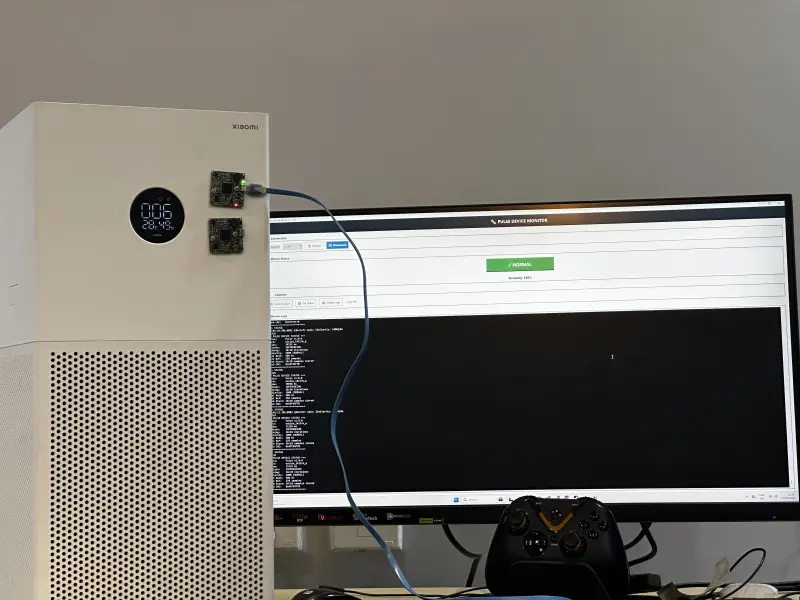
Pulse: Real-time Vibration Anomaly Detection
Pulse is an embedded vibration monitoring system built on Zephyr RTOS for the STM32L412RB microcontroller. It utilizes ST's NanoEdge AI for on-device machine learning to detect mechanical anomalies in motors, pumps, and fans without cloud connectivity. The system features persistent training data storage and a real-time Python-based GUI for monitoring.
MCUboot for STM32
A secure bootloader for 32-bit microcontrollers, specifically modified by STMicroelectronics for integration with the STM32Cube ecosystem. It provides a common infrastructure for flash layout, secure boot, and software upgrades on STM32 SoCs. This version includes hardware-specific optimizations for AES, SAES, and public key accelerators.
STM32CubeH7RS MCU Firmware Package
A comprehensive embedded software platform for the STM32H7RS series microcontrollers. It integrates CMSIS, HAL-LL drivers, and a wide range of middleware including FreeRTOS, LwIP, and FatFS, supporting high-performance applications on STM32H7RS evaluation and Nucleo boards.

CANnectivity
An open-source firmware for USB to CAN adapters based on the Zephyr RTOS. It implements the Geschwister Schneider (gs_usb) protocol, supporting CAN classic, CAN FD, and hardware timestamping across various microcontroller platforms.
SKS AIRSPY ANT+ Community Firmware
An alternative firmware for the SKS AIRSPY tire pressure sensor based on the Zephyr RTOS. It implements the ANT+ TPMS device profile to allow integration with standard cycling computers, replacing the proprietary Bluetooth-only stock firmware. The project targets the nRF52832 SoC and supports features like OTA updates via MCUBoot and BLE logging.
STM32CubeN6 MCU Firmware Package
A comprehensive embedded software platform for the STM32N6 series microcontrollers. It provides HAL and LL drivers, CMSIS modules, and a full middleware stack featuring Azure RTOS (ThreadX), USBX, and FileX. The package includes numerous examples and applications for STM32N6 evaluation and Nucleo boards.
Tenstorrent Zephyr Platforms
The official Zephyr RTOS firmware repository for Tenstorrent AI hardware. It provides comprehensive platform support, custom drivers, and application frameworks for Tenstorrent's AI ULC products, leveraging a specialized Zephyr fork.