Cooperative threads in Zephyr
A Zephyr thread with a negative priority is never preempted by another thread. How should_preempt decides it, and when cooperative threads are the right choice.
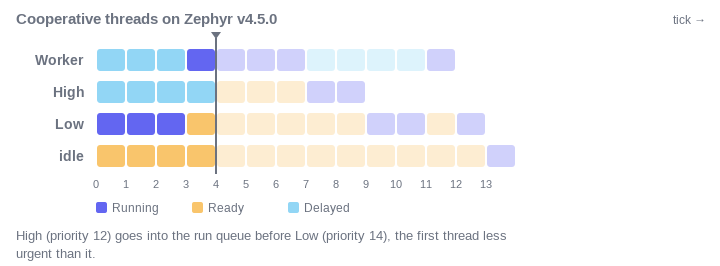
Simulated kernel: Zephyr v4.5.0. This scenario and every other one are in the scheduler playground. The simulator and its data files are not covered by the site's CC BY-SA license; see their license notices.
In a preemptive kernel, a task loses the CPU the moment a more urgent one becomes ready. Zephyr lets you opt out of that, thread by thread. A thread with a negative priority is cooperative: once it runs, no other thread takes the CPU from it. It keeps running until it gives the CPU up itself, by sleeping, waiting for something, or yielding.
Zephyr’s priorities form one scale:
| Priority | Kind | In this scenario |
|---|---|---|
| −16 to −1 | cooperative (K_PRIO_COOP(0) to K_PRIO_COOP(15)) |
Worker: −1 |
| 0 to 14 | preemptible (K_PRIO_PREEMPT(n)) |
High: 12, Low: 14, the main thread: 0 |
| 15 | the idle thread |
A lower number is more urgent, so every cooperative priority is above every preemptible one. A cooperative thread preempts any preemptible thread when it becomes ready; it is only the other way round that does not happen.
The three threads
Low(14) starts at once and has six ticks of work.Worker(−1) sleeps until tick 2, then has four ticks of work, sleeps three ticks, and has one more.High(12) sleeps until tick 3 and has two ticks of work.
As always on Zephyr, a sleep of n ticks ends one tick later than the same vTaskDelay() on
FreeRTOS (see scheduling), so Worker wakes at tick 3 and High at
tick 4.
What happens
- Tick 0:
WorkerandHighstart and go straight to sleep.Lowruns ticks 0 to 2. - Tick 3:
Workerwakes. It is more urgent thanLow, andLowis preemptible, so the tick interrupt switches toWorker. - Tick 4:
Highwakes and enters the run queue ahead ofLow. But the thread that is running isWorker, andWorkeris cooperative.should_preempt()answers no, andWorkerkeeps the CPU.Highis ready and waits during ticks 4, 5 and 6, although it is more urgent than every thread exceptWorker. - Tick 7:
Workercallsk_sleep(). A thread that is going to sleep cannot keep the CPU, so the kernel switches to the most urgent ready thread,High, which runs ticks 7 and 8 and ends. Lowruns ticks 9 and 10.- Tick 11:
Workerwakes and again takes the CPU fromLow. It works one tick and ends.Lowruns its last tick, 12, and ends.
On FreeRTOS, or with Worker given a preemptible priority, High would have run at tick 4.
Where the kernel decides
Every time a thread becomes ready, Zephyr’s update_cache() picks the best candidate from the
run queue and asks whether it may replace the thread that is running:
static ALWAYS_INLINE bool should_preempt(const struct k_thread *thread,
					 int preempt_ok)
{
	/* Preemption is OK if it's being explicitly allowed by
	 * software state (e.g. the thread called k_yield())
	 */
	if (preempt_ok != 0) {
		return true;
	}

	__ASSERT(_current != NULL, "");

	/* Or if we're pended/suspended/dummy (duh) */
	if (z_is_thread_prevented_from_running(_current)) {
		return true;
	}

	/* Otherwise we have to be running a preemptible thread or
	 * switching to a metairq
	 */
	if (thread_is_preemptible(_current) || thread_is_metairq(thread)) {
		return true;
	}

	/* Edge case on ARM where a thread can be pended out of an
	 * interrupt handler before the "synchronous" swap starts
	 * context switching.  Platforms with atomic swap can never
	 * hit this.
	 */
	if (IS_ENABLED(CONFIG_SWAP_NONATOMIC)
	    && z_is_thread_timeout_active(thread)) {
		return true;
	}

	return false;
}kernel/include/kthread.h, lines 225–260 · Zephyr v4.5.0 · Apache-2.0 license
Read it in order:
preempt_okis set when the running thread asked for a switch itself, as ink_yield().- If the running thread can no longer run (it is pending on an object, sleeping or suspended), a
switch is always allowed. This is how
Workergives up the CPU at tick 7. - Otherwise a switch is only allowed if the running thread is preemptible, or the new one is a special “meta-IRQ” thread (not used here).
The test for “preemptible” is a single comparison. Zephyr stores the thread’s 8-bit priority and an
8-bit scheduler-lock count side by side in a 16-bit field, base.preempt. A negative priority sets
the top bit of the priority byte, so the field is 0x80 or more and the thread counts as
non-preemptible. k_sched_lock() sets the other byte, which makes the field even larger. That is
why a thread that has locked the scheduler behaves exactly like a cooperative thread until it calls
k_sched_unlock(). See scheduler lock.
Open the Kernel tab of the code panel and step by Line through tick 4. The simulator stops
on the line of should_preempt() that returns false.
Interrupts are not threads
Being cooperative protects a thread from other threads, not from interrupts. The tick interrupt
still runs on every tick while Worker computes (it is what wakes High), and any other interrupt
handler runs too. If a cooperative thread shares data with an interrupt handler, it still needs to
lock interrupts around that data.
Cooperative threads also only work out if they give the CPU up often. A cooperative thread with a
long computation is a priority inversion built into the design: every preemptible thread, however
urgent, waits for it. Long work in a cooperative thread should call k_yield() now and then. A
yield from a cooperative thread only lets threads of the same or higher priority run, so to let
preemptible threads in, the thread has to sleep or wait.
When to use them
- Code that is not safe to interrupt by other threads, without the cost of a mutex: a group of threads that share data and only switch at points they choose.
- Short, urgent work, often deferred from an interrupt, that must not be interrupted by application threads. Zephyr’s own system work queue thread is cooperative by default.
- Porting code written for a cooperative scheduler.
Everywhere else, prefer preemptible threads and protect shared data with a mutex: the scheduler can then keep its promise that the most urgent ready thread runs.
And FreeRTOS?
FreeRTOS has no per-task cooperative priority. Its nearest tools are:
configUSE_PREEMPTION 0, which makes the whole system cooperative: no task is ever switched out by a tick or by another task becoming ready, only when it blocks or yields. The preemption lesson lets you try it.vTaskSuspendAll()andxTaskResumeAll(), which stop task switches for a section of code while interrupts stay on. This is the counterpart ofk_sched_lock(). The task must not block inside the section.taskENTER_CRITICAL(), which also masks interrupts. It is for very short sections; see critical section.vTaskPreemptionDisable()exists in V11, but only in the multi-core (SMP) build.
What to try
- Set High urgency to 4 or High starts at tick to 2.
Highstill cannot run whileWorkerworks: no preemptible priority is high enough. - Set Worker starts at tick to 6.
Highwakes first and runs at once;Workerthen takes the CPU fromLow, not fromHigh, becauseHighhas already finished.