NuttX
nuttx-12.13.0Features
-
Strict adherence to POSIX and ANSI standards for high application portability.
-
Scalable architecture supporting 8-bit, 16-bit, 32-bit, and 64-bit microcontroller environments.
-
Small footprint optimized for resource-constrained deeply embedded systems.
-
Modular design allowing developers to include only necessary components for a specific build.
-
Built-in simulator enabling development and testing on host terminal environments (Linux, macOS, Windows).
-
Comprehensive support for Symmetric Multiprocessing (SMP) on multi-core hardware.
-
Extensive Virtual File System (VFS) supporting FAT, ROMFS, SMART, and NFS client.
-
Full TCP/IP networking stack with support for IPv4, IPv6, and standard BSD socket APIs.
-
Integrated NX Graphics Subsystem for display management and user interface development.
-
Support for loadable binary formats including ELF and the specialized NXFLAT format.
-
Real-time scheduling with priority inheritance to mitigate priority inversion issues.
-
Unified device driver framework for character, block, network, and specialized hardware devices.
-
Dedicated audio and video subsystems for multimedia-capable embedded applications.
-
Native support for modern programming languages including C++ and Rust.
-
Advanced debugging features including Kernel Address Sanitizer (KASAN), GDB integration, and core dumps.
-
Support for OpenAMP to facilitate Asymmetric Multiprocessing (AMP) communication.
Architecture
Apache NuttX follows a modular, microkernel-like architectural philosophy while maintaining a monolithic structure for performance in its default configuration. The core of the system is built around a strict POSIX-compliant interface, which abstracts hardware complexities and provides a standardized environment for application development. The architecture is divided into several distinct layers: the Hardware Abstraction Layer (HAL) or Architecture-Specific Logic, the RTOS Kernel, and the Application Space.
A key architectural feature is the Virtual File System (VFS), which allows devices, sockets, and files to be accessed through a unified set of standard APIs (e.g., open, read, write). This design pattern extends to its driver model, where hardware is represented as device nodes in the /dev directory. NuttX also supports various build modes, including a Flat Build (all code in one address space), a Protected Build (using an MPU to separate kernel and user space), and a Kernel Build (using an MMU for full process isolation), providing flexibility based on the target hardware’s capabilities.
Core Components
- NuttShell (NSH): A comprehensive interactive shell for system management and debugging.
- Scheduler: A real-time, multi-tasking scheduler supporting FIFO and Round Robin policies.
- Network Stack: A full-featured, BSD-compatible stack supporting various protocols from link to application layer.
- Memory Management: Advanced allocators including support for CCM (Core Coupled Memory) and external RAM.
Use Cases
This RTOS is ideal for:
- Industrial Automation: Suitable for PLC and sensor controllers requiring high reliability and real-time determinism.
- IoT Gateways: Ideal for devices needing complex networking (IPv6, MQTT) and wireless connectivity (WiFi, BLE).
- Consumer Electronics: Used in smartwatches, audio equipment, and appliances that require a small footprint but rich feature sets.
- Automotive Systems: Applicable for telematics and body control modules, leveraging its support for CAN, CANFD, and S32K architectures.
- Drones and Robotics: Excellent for flight controllers and robotic actuators requiring low-latency interrupt handling and SMP support.
- Legacy System Migration: A perfect target for porting legacy Unix/Linux applications to microcontrollers due to its high POSIX compliance.
Getting Started
To begin development with Apache NuttX, developers should first set up their build environment by installing the necessary toolchains for their target architecture (e.g., arm-none-eabi-gcc or riscv64-unknown-elf-gcc). The build system is based on kconfig and make, similar to the Linux kernel. A typical workflow involves selecting a predefined configuration using the ./tools/configure.sh script, followed by running make to generate the binary image.
For those without physical hardware, the NuttX Simulator provides an excellent starting point, allowing the RTOS to run as a native process on Linux, macOS, or Windows. Detailed documentation, including board-specific guides and API references, can be found at the official Apache NuttX Documentation page. Community support is active through GitHub issues and the project’s mailing lists.
Related Projects
View All Projects →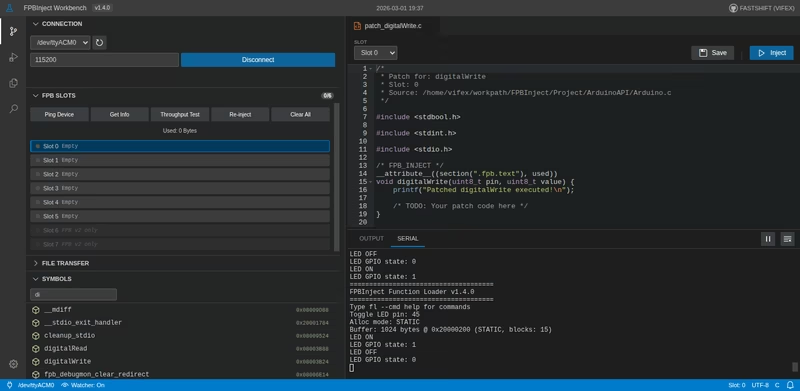
FPBInject
FPBInject is a runtime code injection tool for ARM Cortex-M microcontrollers that allows developers to replace functions on a running device without reflashing, rebooting, or using a debugger. It leverages the hardware Flash Patch and Breakpoint (FPB) unit to redirect execution to custom code in RAM, supporting both bare-metal and NuttX environments on STM32F103 hardware.
Apache NuttX for SF2000
A port of the Apache NuttX real-time operating system targeting the Data Frog SF2000 handheld console. It provides a POSIX-compliant environment with a small footprint, supporting 8-bit to 64-bit microcontroller environments with a focus on standards and modularity.
Apache NuttX NSH Task Demo
A demonstration project for creating and running tasks within the NuttX Shell (NSH) environment. It provides a corrected implementation for task creation on Apache NuttX, specifically targeting ARM64 platforms via QEMU emulation.
Apache NuttX RTOS
Apache NuttX is a standards-compliant real-time operating system (RTOS) designed for 8-bit to 64-bit microcontrollers. It emphasizes POSIX and ANSI standards compliance while maintaining a small footprint, providing a Unix-like environment for deeply embedded systems.
Apache NuttX RTOS for Pine64 Star64
A comprehensive port of the Apache NuttX RTOS to the Pine64 Star64 64-bit RISC-V single-board computer. It provides hardware support for the StarFive JH7110 SoC, including PLIC interrupts, UART, and display controller integration, supported by automated daily builds and extensive technical documentation.
Apache NuttX RTOS for PinePhone
A comprehensive port of the Apache NuttX Real-Time Operating System to the Pine64 PinePhone. It features drivers for the Allwinner A64 SoC, including MIPI DSI display, touch panel, 4G LTE modem, and LVGL graphics integration with multi-core SMP support.
Apache NuttX RTOS on 64-bit RISC-V
A project focused on porting, building, and testing the Apache NuttX RTOS on 64-bit RISC-V architectures. It supports various platforms including QEMU emulation and single-board computers like Star64, Ox64, and Oz64, featuring automated CI workflows and specialized kernel build configurations.
LoRa Test App for Semtech SX1262 and Apache NuttX
A test application for the Semtech SX1262 LoRa transceiver running on the Apache NuttX RTOS. It provides functionality for initializing the radio driver, reading registers, and performing basic PING/PONG message exchanges. The project supports hardware platforms like BL602 and ESP32.